
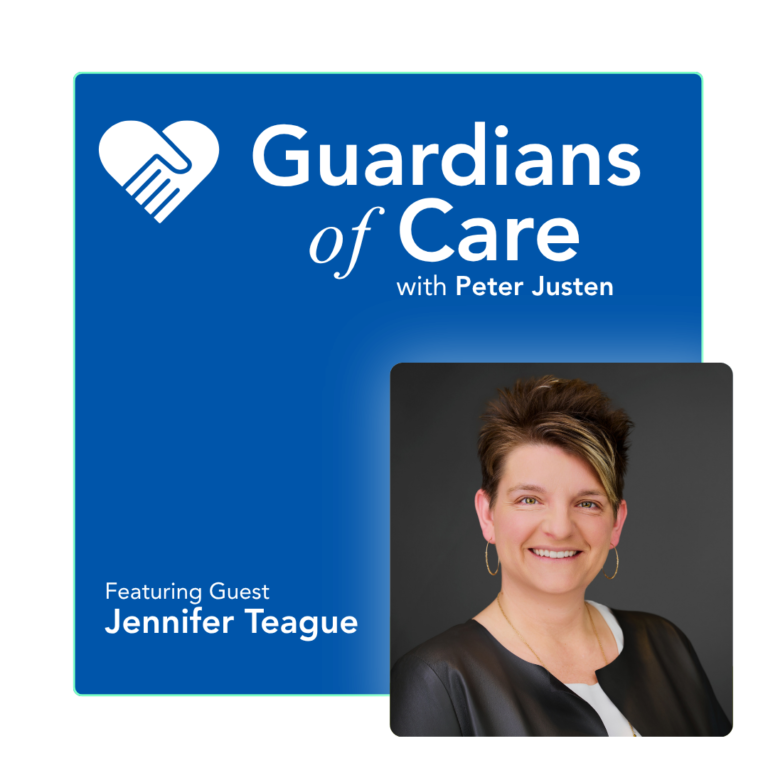
“Oftentimes a lot of people think Medicare is going to cover those long-term services, those long-term care placements. And oftentimes Medicare doesn’t, but Medicaid does.”
- Jennifer Teague
For an older adult, having choices about care can mean staying in the home they love, getting help with everyday needs or being able to see a doctor without worrying about the cost.
For millions of people, Medicaid helps make those choices possible. But the benefits available to older adults are not always easy to understand, especially as they approach 65 and become eligible for Medicare.
In this episode of Guardians of Care, host Pete Justen sits down with Jennifer Teague, Director of Health Coverage and Benefits at the National Council on Aging (NCOA), to talk about the ways Medicare and Medicaid work together and the people helping older adults access the care and support they need.
Teague has spent nearly 20 years working with older adults and their families. Earlier in her career, she sat down with people one on one at a senior center to help them understand Medicare, Medicaid and other benefits.
She saw what could happen when someone took the time to explain the options and help a person enroll. They could get coverage, return to the doctor or discover they had more choices than they thought.
Those are the Medicaid success stories that don’t always make headlines.
Watch the Full Episode on YouTube
Turning 65 is an important milestone. For many older adults, it is also when Medicare becomes a new part of their healthcare coverage.
But for someone who already has Medicaid, the transition can be more complicated than expected. Teague describes the “Medicare cliff” as the point when a person turns 65, becomes eligible for Medicare and may lose Medicaid coverage, sometimes without realizing it will happen.
The change can bring unexpected costs. Medicare may require premiums, deductibles and coinsurance that a person did not have to pay while covered by Medicaid. For someone living on a limited income, those expenses can make it harder to afford care.
Teague points to research from NCOA showing that people who lose Medicaid during this transition can experience poorer health outcomes than those who maintain it. When care becomes more expensive, she explains, people may delay or go without the services they need.
Turning 65 does not mean everyone automatically loses Medicaid. Some people qualify for both Medicare and Medicaid, and the programs can work together to cover healthcare costs and services. Eligibility depends on a person’s circumstances and their state’s rules.
Medicare provides important health coverage for older adults, but it does not pay for every service or every expense.
For people who qualify for both programs, Medicaid may help cover Medicare premiums and other out of pocket costs. It can also cover certain services that Medicare generally does not, including long term care.
“Medicaid can actually help cover that monthly premium. It can cover those coinsurances and deductibles,” Teague says. “It can really provide access to services, supports, and income that individuals didn’t have access to before.”
Even someone who does not qualify for full Medicaid may be eligible for a Medicare Savings Program. Depending on the program, that assistance can help pay Medicare premiums and, in some cases, deductibles and other costs. States administer these programs, and eligibility rules vary.
Teague encourages people to ask about their options rather than assume they will not qualify. Income and resource rules differ by program and state, and some income or resources may not count toward eligibility.
One of the most common misunderstandings Teague encounters is the belief that Medicare will cover long term care whenever someone needs it.
Medicare generally does not pay for ongoing nonmedical long term care, such as help with daily activities over an extended period. Medicaid may cover long term care for people who meet their state’s requirements.
That care is not limited to a nursing home. Medicaid can also cover home and community based services that help eligible people remain in their homes and communities. Available services and eligibility requirements vary by state.
For an older adult, that support can mean continuing to live at home with help. For a family, it can open the door to options they may not have known existed.
Teague encourages people to start those conversations early. Where would a parent or loved one want to receive care? What would they need to remain at home? If a facility became necessary, where would they feel comfortable?
Talking through those wishes before a crisis gives families more time to explore the possibilities and make decisions together.
Teague shared the story of a woman who had lost Medicaid coverage and was experiencing severe back pain. The cost of appointments and copays had become too much, so she stopped going to the doctor.
A local Benefits Enrollment Center helped her reapply for Medicaid, and she regained coverage. When the organization followed up a few months later, she had returned to the doctor, her back pain had started to improve, and she was no longer facing the same medical bills and worry.
It is one example of what Medicaid can make possible and how much the people helping someone access it matter. A local organization helped one woman navigate the process. With coverage in place, she could get back to the care she needed.
Finding the right program can be difficult, especially when someone does not know where to begin. Teague wants older adults and their families to know they do not have to figure it out alone.
The National Council on Aging partners with local organizations that help people understand and enroll in benefits. Those organizations meet with individuals and families, answer questions and provide guidance through the application process.
NCOA also offers BenefitsCheckUp, a free online tool that helps people explore programs they may be eligible for, including Medicaid, Medicare Savings Programs, food assistance and other services. Users can enter their ZIP code to find resources and organizations in their communities.
People who prefer to speak with someone can call NCOA’s Benefits Helpline at 1-800-794-6559. Trained counselors can help callers explore benefits and connect with local assistance.
Area Agencies on Aging, senior centers, State Health Insurance Assistance Programs and state or local Medicaid offices can also help people understand their options and take the next step.
Behind every application and eligibility determination is a person trying to get the care or support they need. And often, there is someone helping them along the way.
For Teague, that has meant sitting with families, answering questions and helping people take the first step. Today, she and the team at the National Council on Aging help connect older adults with local organizations doing that same work in communities across the country.
The result can be a return to the doctor, help paying for care or the support someone needs to remain at home. These are the everyday successes that show what Medicaid makes possible.
Teague’s advice is simple: do not rule yourself out before asking.
“Don’t let the income guidelines be the deciding factor to not apply,” she says. “Go ahead and take this step to reach out.”
Jennifer Teague is Director of Health Coverage and Benefits at the National Council on Aging. She has spent nearly 20 years helping older adults and their families understand and access healthcare coverage and other benefits. Her experience includes working at the state and local levels, serving as a senior center director and helping individuals navigate Medicare and Medicaid.
Guardians of Care highlights the people, programs and partnerships that make Medicaid work. Hosted by Pete Justen, the podcast brings together leaders and change-makers from across the Medicaid ecosystem to share the successes, challenges and practical lessons behind their work—and to help more people understand how Medicaid works and why it matters.
Medicare Savings Programs — Medicare.gov
Long Term Care Coverage — Medicare.gov
Medicaid and Medicare — Medicare.gov