
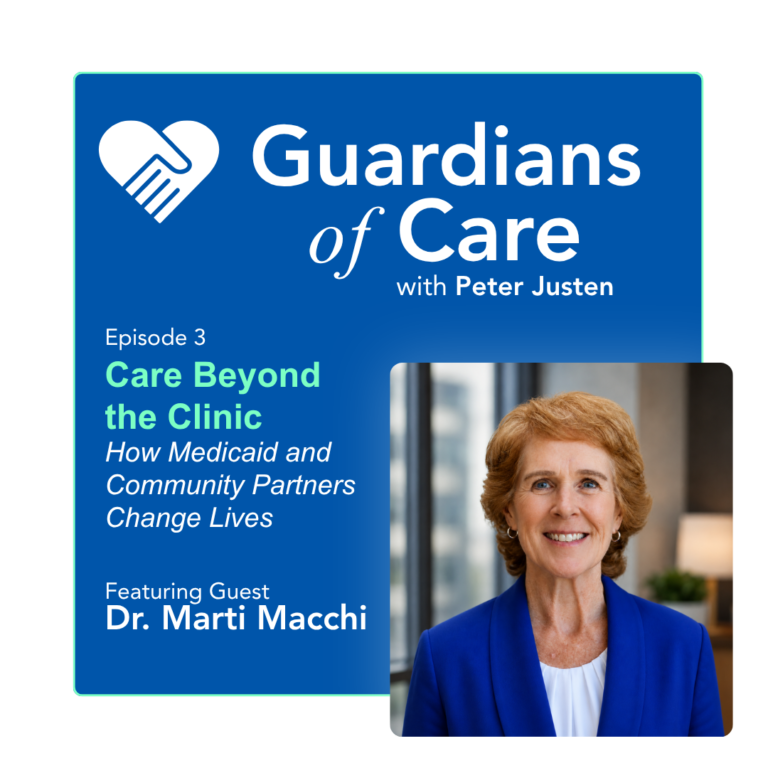
“Partnerships are truly needed.”
- Dr. Marti Macchi
When we think about healthcare, most of us picture a visit to the doctor, a hospital stay or a prescription. But some of the care that makes the greatest difference happens outside the clinic.
It might be a diabetes prevention class that helps someone make changes before they become sick, or a meal prepared specifically for a person managing kidney disease. These services can help people stay healthy, manage a serious illness and remain in their homes. But getting them to the people who need them takes more than a good idea. It takes partnerships, a way to pay for the work and an understanding of what people need to make use of it.
That is where Dr. Marti Macchi has spent much of her career. In this episode of Guardians of Care, host Pete Justen talks with Macchi, President and CEO of Project Angel Heart, about what happens when Medicaid and community organizations work together to bring care into people’s everyday lives.
Over more than 25 years in public health, Macchi has helped expand access to diabetes prevention through Medicaid and, now, leads an organization that prepares and delivers medically tailored meals to Coloradans living with serious illnesses. Her work shows how much is possible when healthcare systems and community partners come together around the people they serve.
Watch the Full Episode on YouTube
There are programs across the country that have been shown to prevent illness and improve people’s health. But as Macchi explains, knowing a program works and making it available to the people who need it are two different challenges.
Someone has to deliver the service, and there has to be a sustainable way to pay for it. Healthcare organizations, public health agencies, Medicaid programs and community partners also have to work together to understand what it will take to make the program successful in the communities they serve.
That last part matters. A program cannot simply be lifted from one community and dropped into another with the expectation that it will work exactly the same way. The people delivering it need to understand the circumstances, challenges and priorities of the people they are trying to reach.
Macchi has seen what happens when those pieces come together. One of her favorite examples started with a question: How could more people covered by Medicaid get access to a program designed to prevent type 2 diabetes?
Earlier in her career, Macchi worked at the National Association of Chronic Disease Directors as the Centers for Disease Control and Prevention was expanding the National Diabetes Prevention Program.
The program helps people at risk of developing type 2 diabetes make changes that can support their health. It had already shown promise, but there was more work to do to make it available in communities and ensure people had a way to pay for it.
With funding from the CDC, Macchi’s organization worked with Oregon and Maryland on a demonstration to help bring the program to people covered by Medicaid. The project brought state Medicaid agencies, public health teams and other partners together to work through how the program could be delivered and paid for over time.
The work helped create tools and lessons that other states could use. Today, 31 states have achieved varying levels of Medicaid coverage for the National Diabetes Prevention Program, using approaches that differ from state to state.
For Macchi, that is a success worth celebrating. A program that helps prevent a serious chronic illness is reaching more people because partners took the time to figure out how to make it work.
The diabetes prevention project also taught Macchi and her partners something important about the people they hoped to reach.
The program could teach participants how to prepare healthier meals, but what if someone was experiencing food insecurity? They could offer an in person class, but what if a participant did not have transportation or childcare? And what happened when someone facing unstable housing had to leave the program before it was complete?
These were not questions the program could ignore. If the goal was to help people make changes that supported their health, the partners also needed to understand what might stand in their way.
Macchi says that listening to participants and accounting for those challenges helped create a stronger approach for people covered by Medicaid. It is a lesson that has stayed with her: To make a program work, start by understanding the lives of the people it is meant to serve.
Today, Macchi leads Project Angel Heart, a Colorado organization with a mission that grew from a simple act of kindness.
In 1991, a community member and a few friends wanted to help people living with HIV and AIDS who were dying in isolation. A local restaurant donated a pan of lasagna, and the group divided it into meals for people who needed them.
More than three decades later, Project Angel Heart prepares and delivers medically tailored meals to Coloradans living with serious illnesses. Its chefs and registered dietitians work together to design meals for people managing conditions such as kidney disease, congestive heart failure, cancer and HIV/AIDS.
Macchi describes the idea as getting the right nutrition to the right person at the right time. For someone who is sick, that can mean having food that supports their treatment without the added burden of figuring out what to buy, how to prepare it and whether it meets their medical needs.
The support can make a difference for caregivers, too. Macchi shared a story about a family caring for someone with a traumatic brain injury. They told her son, a neurologist, how much it helped to receive meals each week from Project Angel Heart. Knowing food was taken care of gave them one less thing to worry about as they focused on their loved one’s care.
Preparing and delivering meals takes resources, and Macchi says sustainable payment is essential to making the service available to people who need it.
In Colorado, Project Angel Heart works with Medicaid accountable care entities that pay for medically tailored meals for eligible members. The organization has shared data with its partners on how the meals can support people at home and reduce healthcare use, helping build a case for including the service alongside other care.
Those relationships can also open the door to other support. When Project Angel Heart works with a client who has Medicaid coverage, the team can help identify other needs and connect that person with services that may be available.
It is an example of what Medicaid and community partners can accomplish together. The healthcare system helps make the service possible, while an organization rooted in the community brings the expertise, relationships and care directly to the person who needs it.
Macchi shared the story of a client in northeastern Colorado who developed type 1 diabetes as a child and later experienced severe chronic kidney disease.
When he could no longer work, his income dropped and he moved farther from Denver to find a place he could afford. He now travels more than an hour to a dialysis center three times a week for treatment.
Project Angel Heart found a way to make its meal delivery work around that schedule. On the days he receives dialysis, the team delivers his medically tailored meals to the center.
He has told the organization how much those meals have helped him manage his condition, and he has gotten to know the volunteers who bring them to him. For Macchi, his story is a reminder that providing care sometimes means understanding what a person’s day looks like and finding a way to meet them there.
Project Angel Heart’s work reaches beyond its healthcare partnerships. The organization also works with food banks to help connect people living with chronic illnesses to food that meets their dietary needs, and with shelters and other community partners serving people who may be managing an illness while facing housing challenges.
Each organization sees a different part of a person’s life. By working together, they can recognize needs that might otherwise go unnoticed and help connect people with support.
That same idea runs through Macchi’s work, from diabetes prevention to medically tailored meals. Medicaid can help create a way to pay for a service. Community organizations bring knowledge of the people and places they serve. Healthcare partners help connect those services to a person’s care.
Together, they can help someone avoid developing diabetes, manage a serious illness at home or find a little relief while caring for a loved one. These are the stories that show what Medicaid can make possible and the people and partnerships that help make it work.
About Dr. Marti Macchi
Dr. Marti Macchi is President and CEO of Project Angel Heart, a Colorado organization that prepares and delivers medically tailored meals to people living with serious illnesses.
She has spent more than 25 years working in public health and chronic disease prevention. Earlier in her career, she served as Chief Program Strategy Officer at the National Association of Chronic Disease Directors, where she helped advance Medicaid access to the National Diabetes Prevention Program.
Guardians of Care highlights the people, programs and partnerships that make Medicaid work. Hosted by Pete Justen, the podcast brings together leaders and change-makers from across the Medicaid ecosystem to share the successes, challenges and practical lessons behind their work—and to help more people understand how Medicaid works and why it matters.
Medicaid Coverage for the National DPP Demonstration Project — National DPP Coverage Toolkit
Project Angel Heart — Learn more about medically tailored meals and the organization’s work in Colorado